관점 · 2026년 6월 25일 · 29분
Redefining Humanness in the Age of AITaste and Digital DNA

Sujin Keen
(66)DAYS 파운더 · 서울대 인지과학 석사과정

목차
Digital — Crying Out for Humanness Amid AI-ness
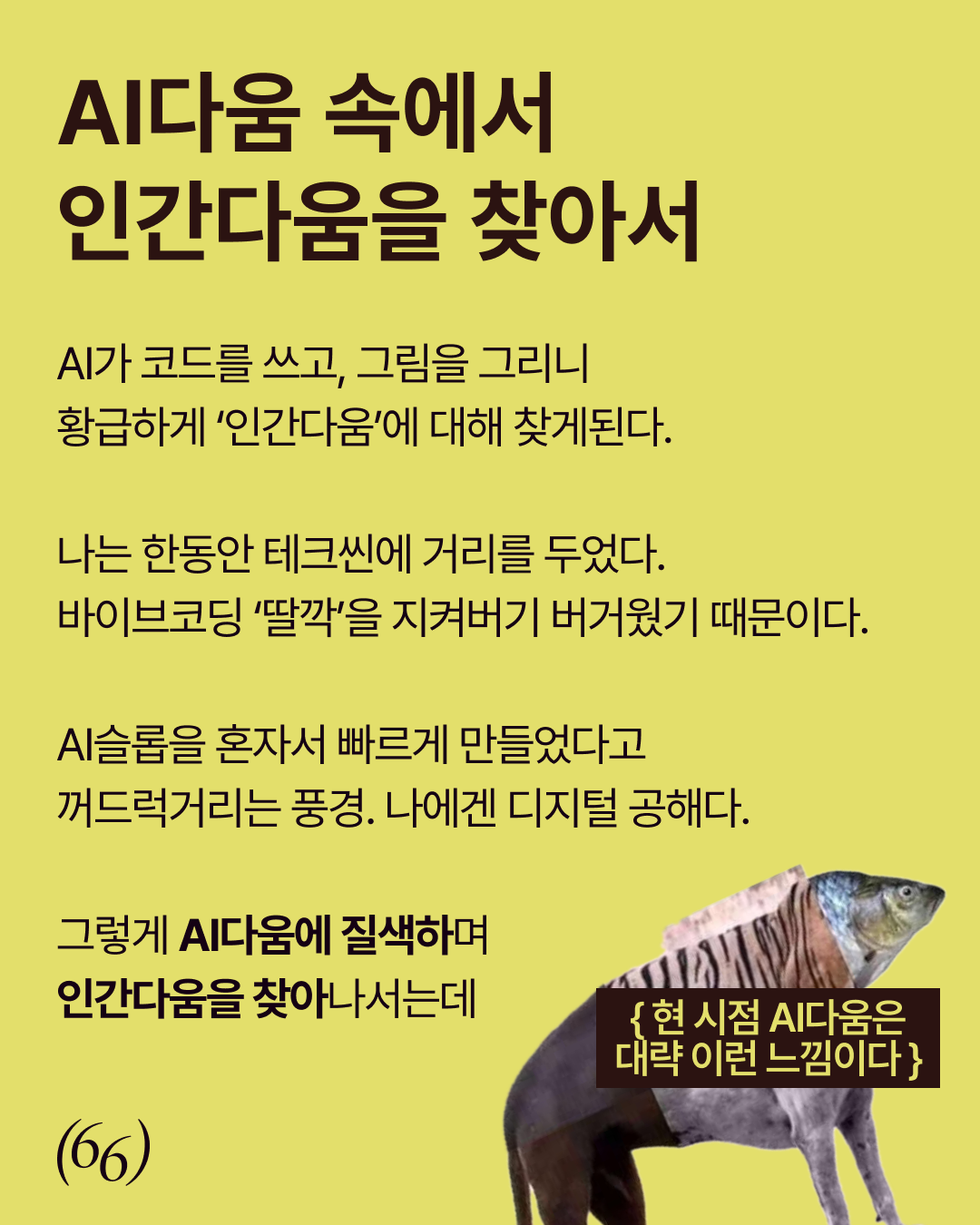
The moment AI started writing poems and writing code, everyone, gripped by existential dread, scrambled to find "humanness." But honestly, before that grand philosophical question, what hit me first was a petty irritation with "AI-ness." At some point, the tech scene I belong to began chasing nothing but "efficiency." How many hours it took to make something became the standard for applause, more than what was actually made — and nobody flinched at the ugly stuff AI spat out. Great, you can do it alone (a.k.a. great, you can fire everyone). Amazing, it's fast (so they'll churn out ugly things even more obsessively). That picture kept tormenting me. If Steve Jobs came back, he'd click his tongue, I'd mutter to myself.
So I quietly stopped going to tech meetups. Watching the flood of output became too much to bear. Instead, I picked up phrases like "humanness in the age of AI" and shifted my center of gravity toward brand and wellness. And there, I could breathe again. Time not chased by speed, the sense of looking inward. It was clearly something I needed.
But I couldn't stop there. Rest alone left something missing. I'm a maker by nature, so sitting on my hands made me itch. Slow was fine, but I still wanted to make something I could call "mine." So there I was, fitting into neither side, standing somewhere in between — in the "middle layer." Not wanting to go back to the side that just stamps things out fast, but unable to settle into the seat where you put everything down and only rest. Someone who hates being jerked around by speed, but doesn't want to stand still either.
This piece is a signal sent to anyone who has ever felt a similar thirst from that awkward in-between place.
Analog — Just Retreating Into the Past, Is That Okay?
We talk about "humanness" as if it were some eternal, unchanging essence. But trace back even a little, and humanness has never once been fixed. Every time — each time machines took one of our abilities away — it was redefined somewhere just outside their reach.
Writing did it. Socrates was suspicious of writing. In "Phaedrus," he warns that the written word would ruin people's memory and only inflate their "pretense of knowing." In his world, the measure of intellect was "memorization." The ability to recite entire epics mouth to mouth was itself culture. Then writing outsourced that memorization. An ability that was once the core of humanness was handed to a tool. And humanness didn't die. It simply moved from "the power to memorize" to "the power to read, interpret, and write."
The printing press did it too. Before movable type, a scribe's handwriting was, in itself, both skill and value. The press made that craft worthless overnight. The calculator took mental arithmetic; the camera took "the hand that draws realistically." But ironically, once photography took over "drawing things exactly," painting was instead set free. Painters who no longer needed to reproduce objects moved to impression, to abstraction, to "interpretation that only humans can do." The machine took an ability, and as a result humans moved toward something more human — they defined a "new humanness."
So the conclusion is clear. Humanness doesn't lie in preserving the past. Once the boiler is in, there's no reason to keep burning firewood in the hearth. Humanness is something deeply historical and mutable, shifting its place every time a new technology arrives. The thing that doesn't stay fixed, the thing that adapts to its environment — I believe that alone is humanness.
So the question is this. What ability did AI take this time, and where does humanness move to now?
What If AI Does the Work Better Than Me? What's Left for Me?
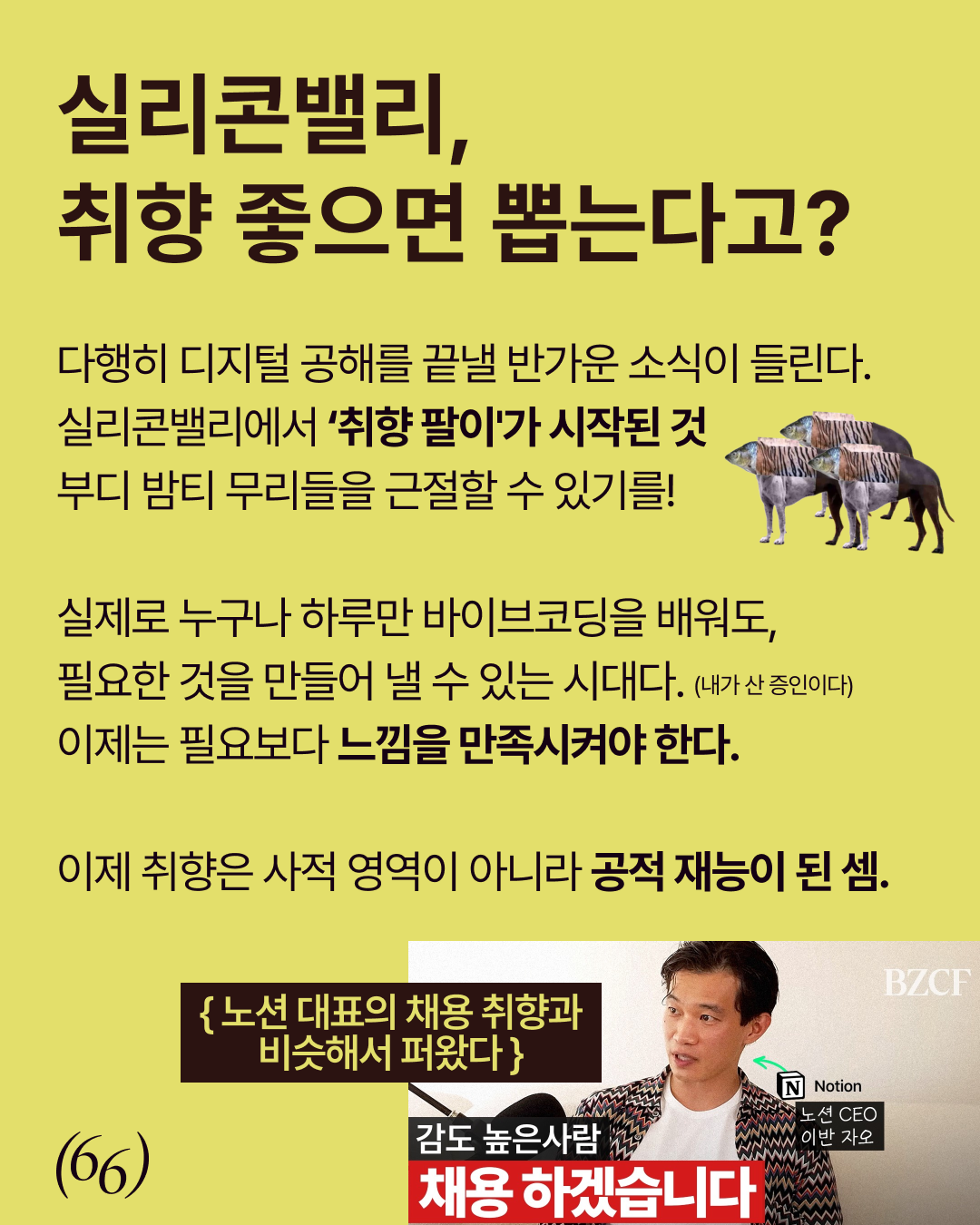
What AI took wholesale is "execution." The realm of the "hands": writing code, writing prose, making images, putting together reports. Now anyone can make anything. When making becomes nearly free, what grows scarce isn't the ability to make — it's the ability to choose "what to make." I call that taste.
There's a saying going around Silicon Valley these days — "good taste gets you hired" — and it comes from the same place. In an era flooded with "AI slop," the sense to sift gold from stone — taste itself — has become a "public asset." (Look at the scene where a startup like Taste Labs raises money declaring it will build "a taste layer for AI.") While Taste Labs grafts taste onto AI, I want to come at it from the other direction. How do we preserve an individual's taste as Digital DNA?
Taste doesn't come into being through declaration. It isn't made by grafting "this is my taste" onto an AI. Plenty of people spend money trying to cultivate taste. But I did the opposite. I won projects that paid me. It sounds strange, but this was far more effective. The moment money is on the line, an "obligation" appears. You have to research, see it for yourself, report, and produce deliverables. So I went around fashion and F&B sites and wrote countless reports — and at some point, those records had turned me into a "person with taste."
So taste grows on top of the records I leave. As daily records accumulate, patterns emerge, and from those patterns my own principles and taste are "discovered" after the fact. Just as you estimate a distribution from scattered data, taste is extracted from the accumulation of my records. And those records are my own "Digital DNA." A new kind of human DNA, going beyond the DNA carved into the body.
This isn't just my claim, actually. People who built worlds of their own were, almost without exception, "people who recorded enormously."
Take Matthew McConaughey, the actor from the film Interstellar. This world-famous actor, who even won the Academy Award for Best Actor, has in fact recorded every single day for 35 years since he was fifteen. He bound that vast archive into a memoir, "Greenlights," and it became a New York Times bestseller. His method of recording is almost absurdly simple. "No Wrong, Just Write."
Doodle if you want, draw if you want, scribble if you want. There are no rules to journaling. Once you've written it all down and look back, you'll start to see who you are.
There's nothing to overthink. Don't try to write well — just record enormously. That simple repetition builds one person's world.
You don't have to look far. Jennie, an artist familiar to us all, is likewise known as someone who has steadily recorded herself. Behind the dazzling stage, the notes and diaries she left were, in the end, the process of drawing for herself what to make and who to become. Records shape "you" like that, regardless of field.

While Using the Same ChatGPT, What Sets Me Apart?
At this point the story drifts off into space for a moment. (My overactive imagination strikes.) There's a forecast that the era of "one agent per person" is near. Kim Seo-jun (Hashed), the CEO, predicted that in developed countries the era of one agent per person is "highly likely" to begin. Without a personal agent, he said, you'll barely be able to tap AI's potential. Now the human role shifts from a "worker" who does the work directly to a "boss — a director" who gives goals to AI and verifies them.
But here a curious question remains. If everyone runs their own agent on top of the same large language model, then on that very same large language model, what makes "my" agent mine? There's only one answer. The records I've built up all this time. My principles, my taste, my discernment. Just as raising a strong game character takes good design, raising my agent to be like me takes a blueprint — namely, records. That's why the phrase human-in-the-loop is so loaded. We aren't being replaced by AI; through our records, we remain inside the flow of moving forward together with AI. And what keeps us "ourselves" all the way through is records.
(Once I get here, I find myself imagining even further. A world where someday my records become an agent that resembles me, and even after I'm gone, connects and converses with someone's present. Adding one more book at a time to humanity's library. That's still an unrealized, declarative future, so I'll fold it away for today's piece. But I truly believe such an era will come.)
Why Should We Record for 66 Days? — A Serious Obsession With the Myelin Sheath
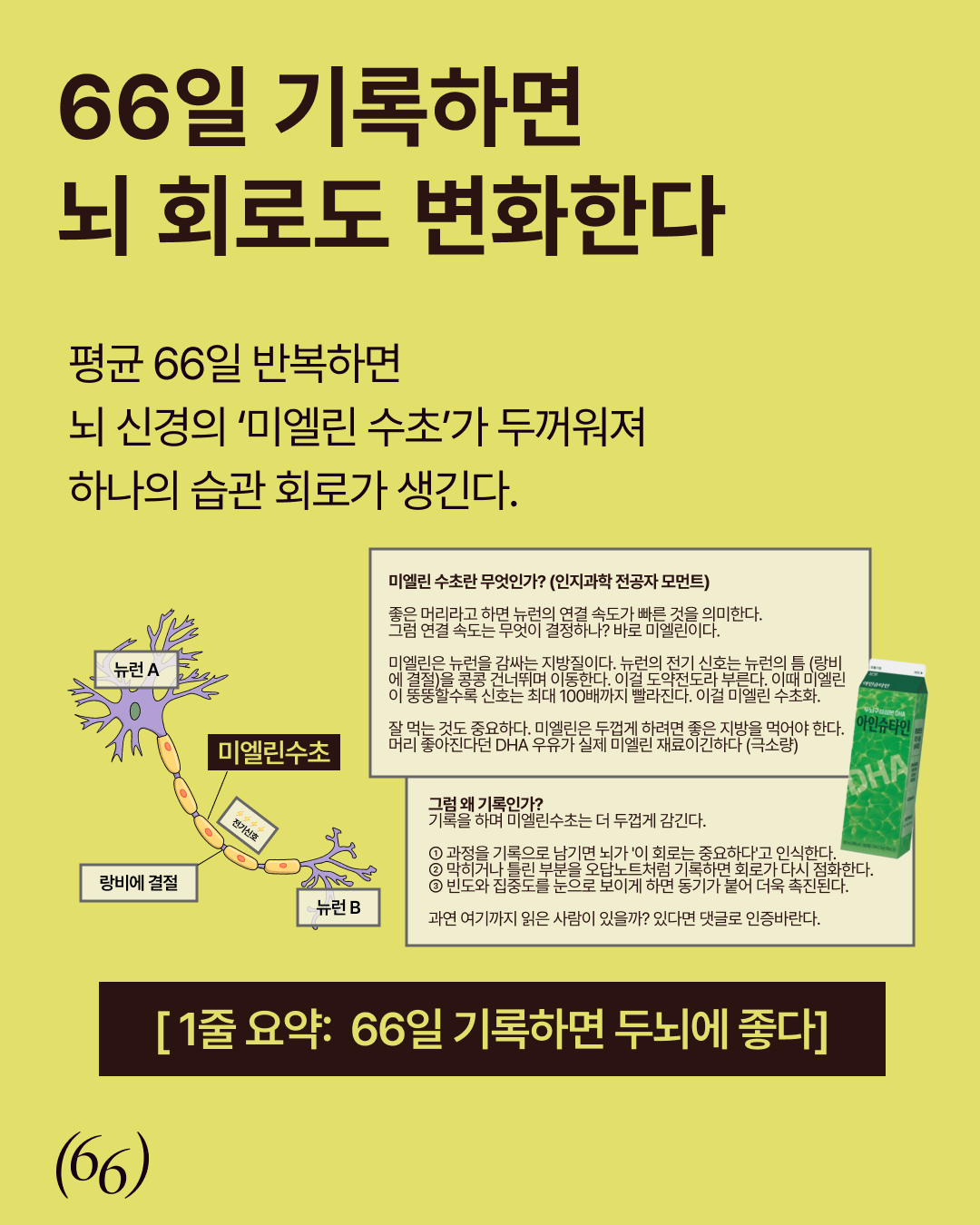
In the 66 days it takes a habit to be carved into the brain, a new circuit of thought (a fiber-optic cable) gets laid down.
Let's come back from space to the ground. Setting aside the cosmic fantasy of uploading my consciousness to the internet someday, what's the immediate payoff of recording for 66 days?
According to UCL research, it takes an average of 66 days for a new habit to take hold. Why does repetition, of all things, change a person? When this part comes up, my cognitive-science-major moment kicks in. So, caution: it gets a bit serious. Maybe because this is also the reason I'm so earnest about this work.
A good head ultimately means fast connections between neurons. What determines that speed is myelin (the myelin sheath), the fatty insulator wrapping a neuron's axon. The electrical signal hops across the gaps in this sheathing (the nodes of Ranvier), bounding along — this is called saltatory conduction. The thicker the myelin, the faster the signal, by up to 100 times. So repetition is, quite literally, laying "fiber-optic cable" inside the brain.
And this myelin sheath becomes most active "at the very moment you recognize and correct a mistake." Recording hits exactly that spot. Logging the process makes the brain recognize "this circuit matters" and accelerates myelination; leaving the stuck or wrong parts behind re-ignites the circuit; and making frequency and intensity visible adds motivation, which promotes neuroplasticity. The conclusion: 66 days of recording isn't a mere resolution — it's physical wiring work, winding one more layer of myelin onto the axon every single day. …Yes, I know. That got too serious. (End of the EBS knowledge documentary.)
Why Should We Share Each Other's Records? — Let's Build a Connected Community Brain
Because you can't survive 66 days alone, and it's only when we peer into each other's records that we truly grow together.
Online course completion rates are usually 5% — and honestly, it's not that the courses are bad; it's that you were alone. People can't survive 66 days on their own.
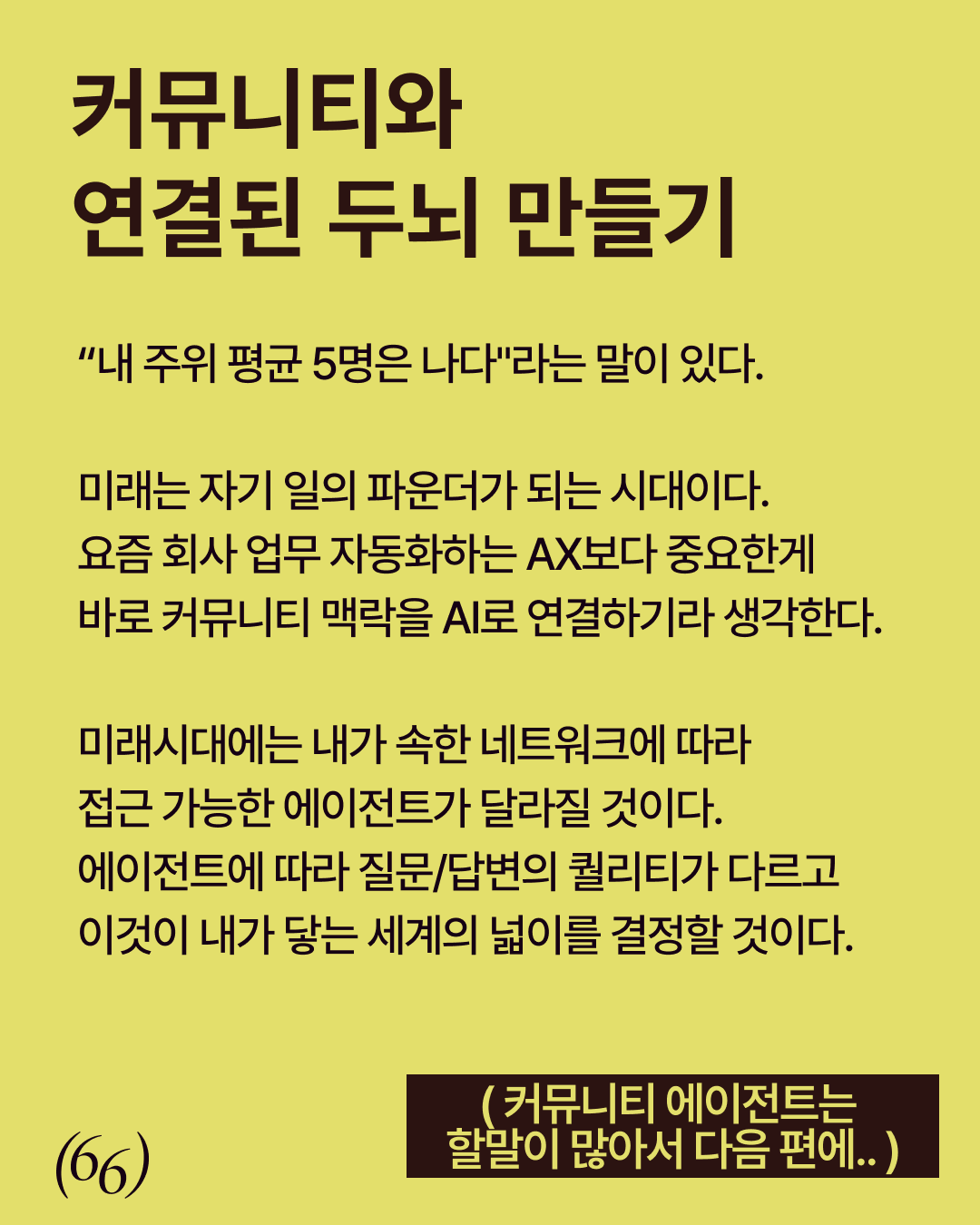
As the saying goes, "the 5 people around me are my average." In an age where AI does everything, what ultimately can't be replaced is which network I place myself in. Not what you know, but with whom and where you stand. The world these days makes a company's "AX (AI transformation)" its headline. But seen not from the organization but from the seat of "me," there's a different, truer question. Which community will I belong to from now on, and what information will I exchange within it. If AX is the transformation of an organization, this is the transformation of an individual. And honestly, the latter changes me far more.
I see this as part of a larger current. Now that AI turns one person into a whole team, the "age of the company" is fading. Anyone can stand as a solo founder. But standing alone is different from being left behind in loneliness. What fills the place where the fence of the company once stood is the "solidarity" of solo founders walking the same path. The age of the organization passes, and the age of solidarity arrives. Community is the soil where that solidarity grows. That's why we're building a community, not a service app.
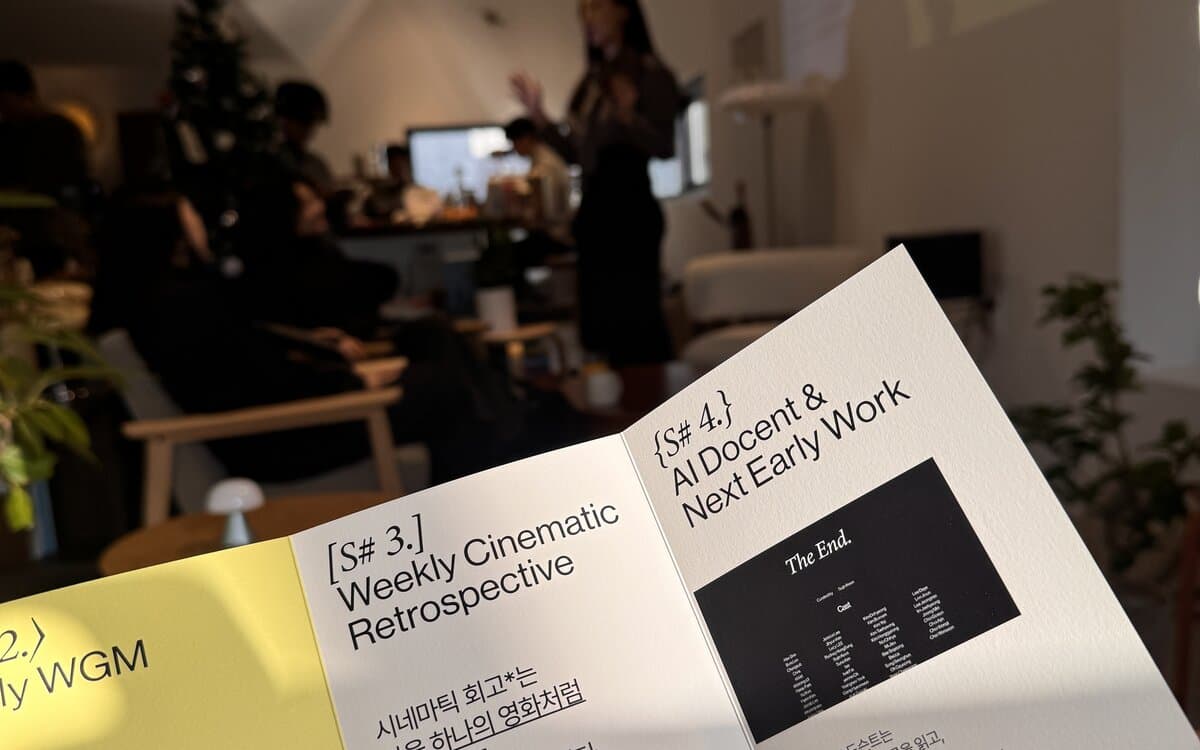
What Counts as a Human Record? — The Things We'll Record Together
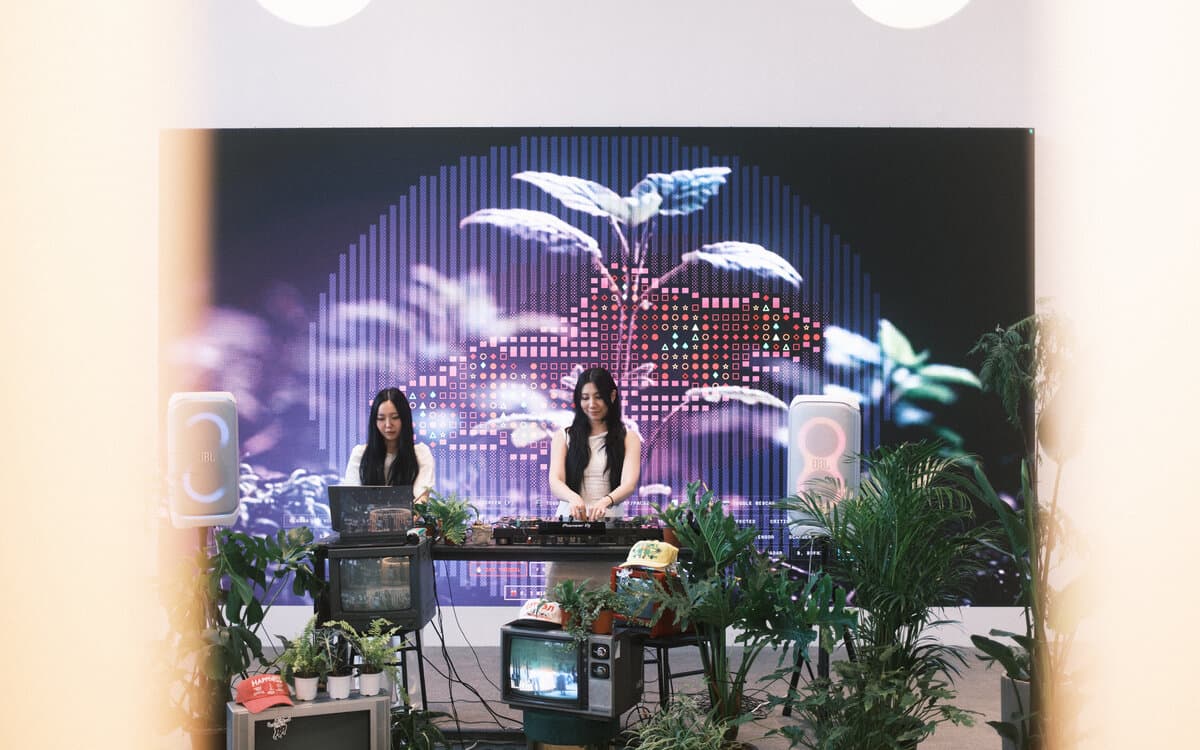
Interestingly, these gardens rest neatly upon the human body, or upon the layers of cognition. Seen through a cognitive information-processing model — AI is the side that pours out endless external input, and humanness is the processing power that turns that input into "Digital DNA." Each garden trains one stage of that processing.
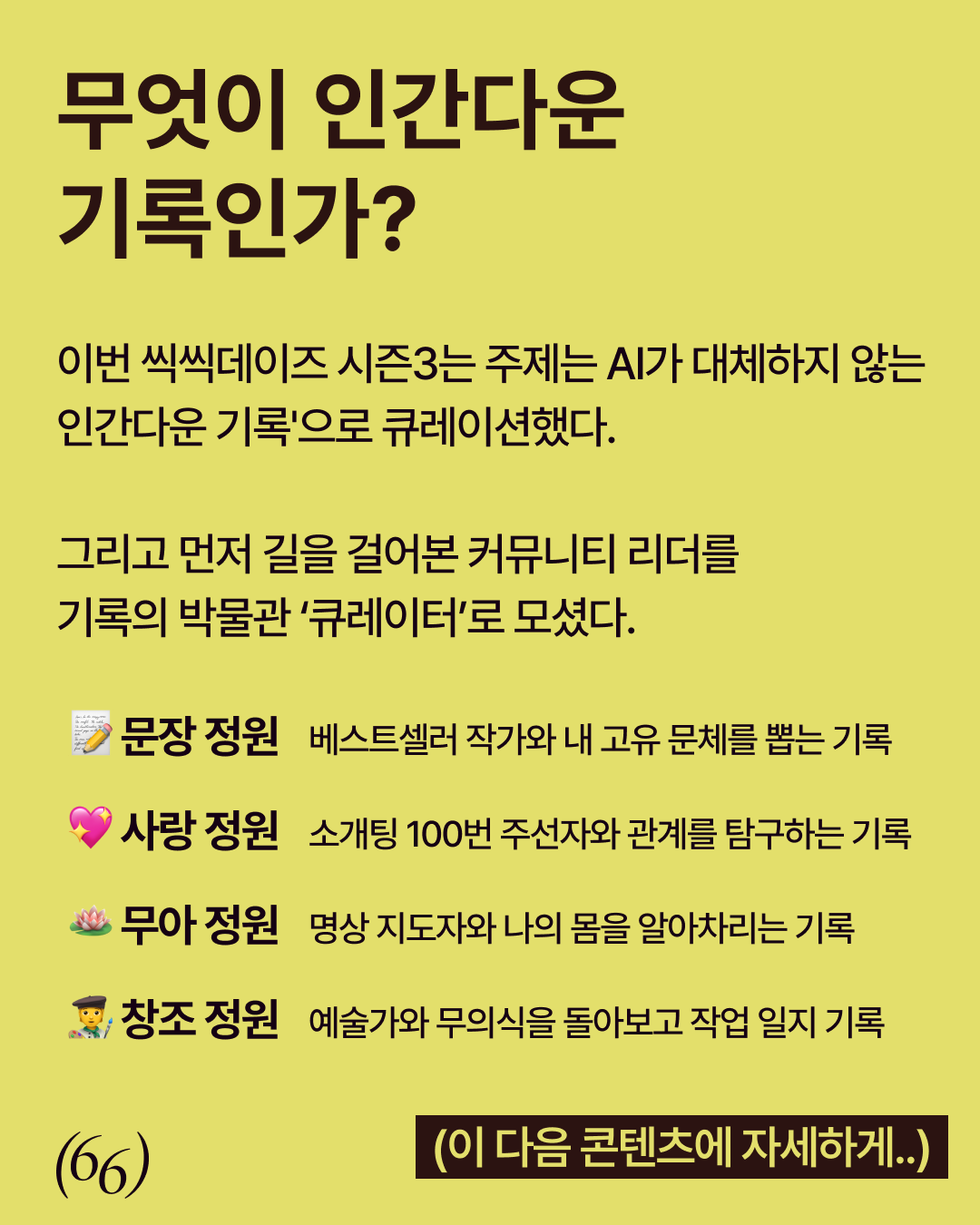
- 💗 Love Garden (relationships) — What AI ultimately can't mimic is the chemistry between people. Six days designed by a curator who has set up 100 blind dates. Instead of filtering by specs, you get to know each other's grain through records first.
- 🎨 Creation Garden (the unconscious) — The more it's an age where anything can be "generated," the more precious the uniqueness drawn up from within. One page a day with Julia Cameron's Morning Pages — 66 days of waking your dormant creativity.
- 🧘 Selflessness Garden (the body) — Even when you close the laptop, the windows in your head don't shut off. This garden doesn't try to erase the ego. It just steps back and observes. So that you "transcend" the ego rather than remove it.
- ✍️ Sentence Garden (language) — Precisely because "write it for me" has become familiar, it becomes important to compose your own sentences and have your own style. Only someone with their own style can use AI on a higher plane. So this garden does the reverse — for 66 days, you write "without AI."
- 🧭 Earlywork Garden (the brain) — In an age where AI took over the work, what ultimately remains is the power to create your own customers directly. From worker to director. One person tries running a small company hands-on.
And this list keeps growing. Lately I've been cooking up new schemes with a wildly fun philosophy creator, and I've put in a request to a luxury-brand member who knows both taste and style to build a real taste layer together. And while Jaeyong is over in Canada, we've even been tossing around the idea of moving the Romance Garden to Canada altogether.
The Museum of Records? What on Earth Is That?
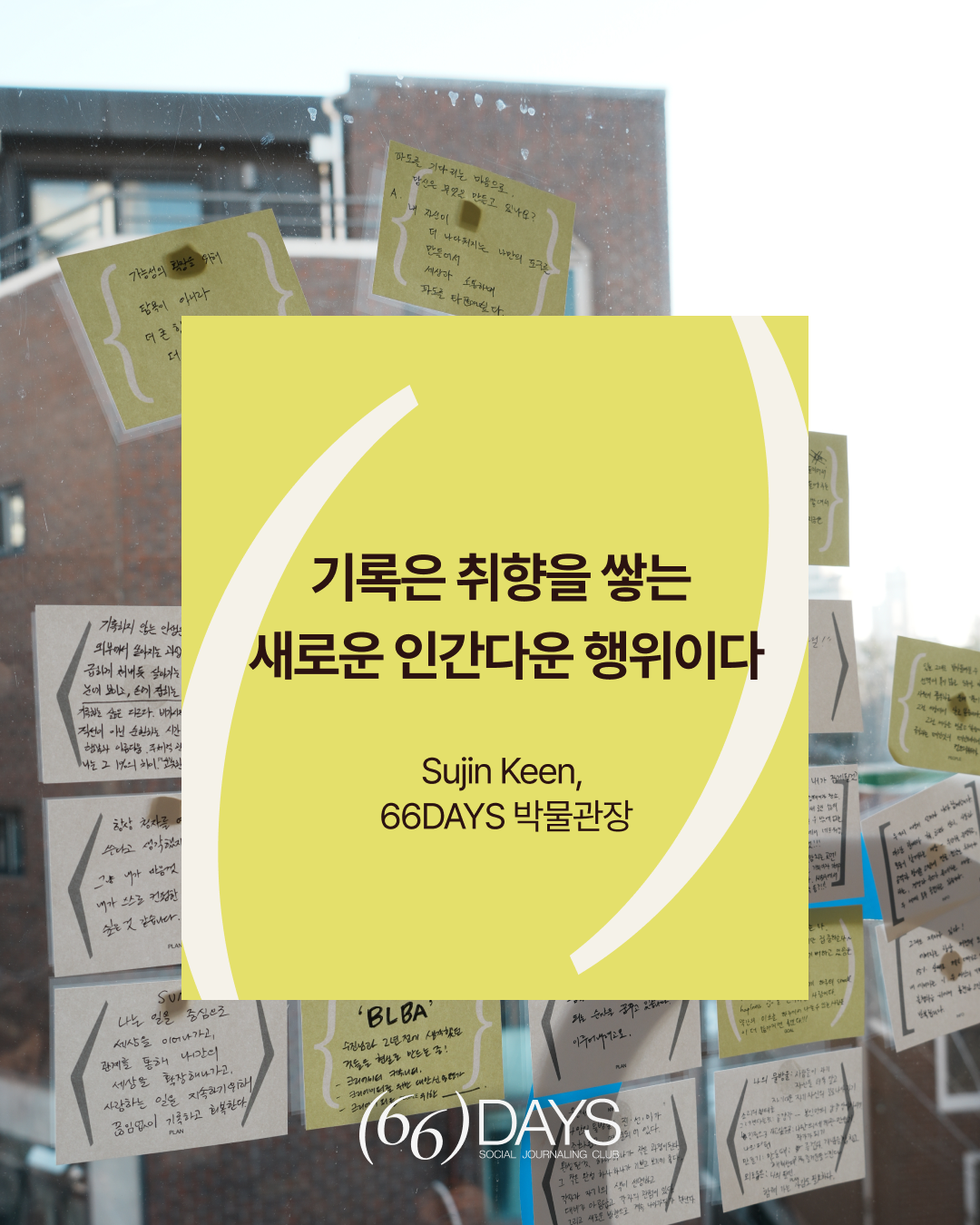
It's my records accumulating into a "living library" that someone, far in the future, will come to. What I'm showing now are its scrappy little moments.
Honest confession: what I'm showing now isn't everything I've imagined. In my head there's a museum where records are alive and moving, a library that converses across time and space. But I know that if you wait for the final boss, you'll never put anything out. "this is never that" — this is reality, that is the ideal. Like this clothing brand's name, I'm distributing things bit by bit, broken into pieces, without ever showing all I imagined. And in doing so, I think I want to say this: that this still isn't everything. That there's a next, so keep watching. Still, for now, I give today's best. 66 days, one line a day. It may look small, but this is one of the scrappy little moments of that vast library.
To make something is, I suspect, always this kind of feeling. This isn't everything, so please watch the next me too. Imagination-debt isn't repaid but keeps accruing, and that's what drags me onward to the next.
And this process — the process of those shabby moments itself — I record too, to send a signal to the future. Hoping someone can converse with the me of this moment, today again I record in three dimensions. 🌱
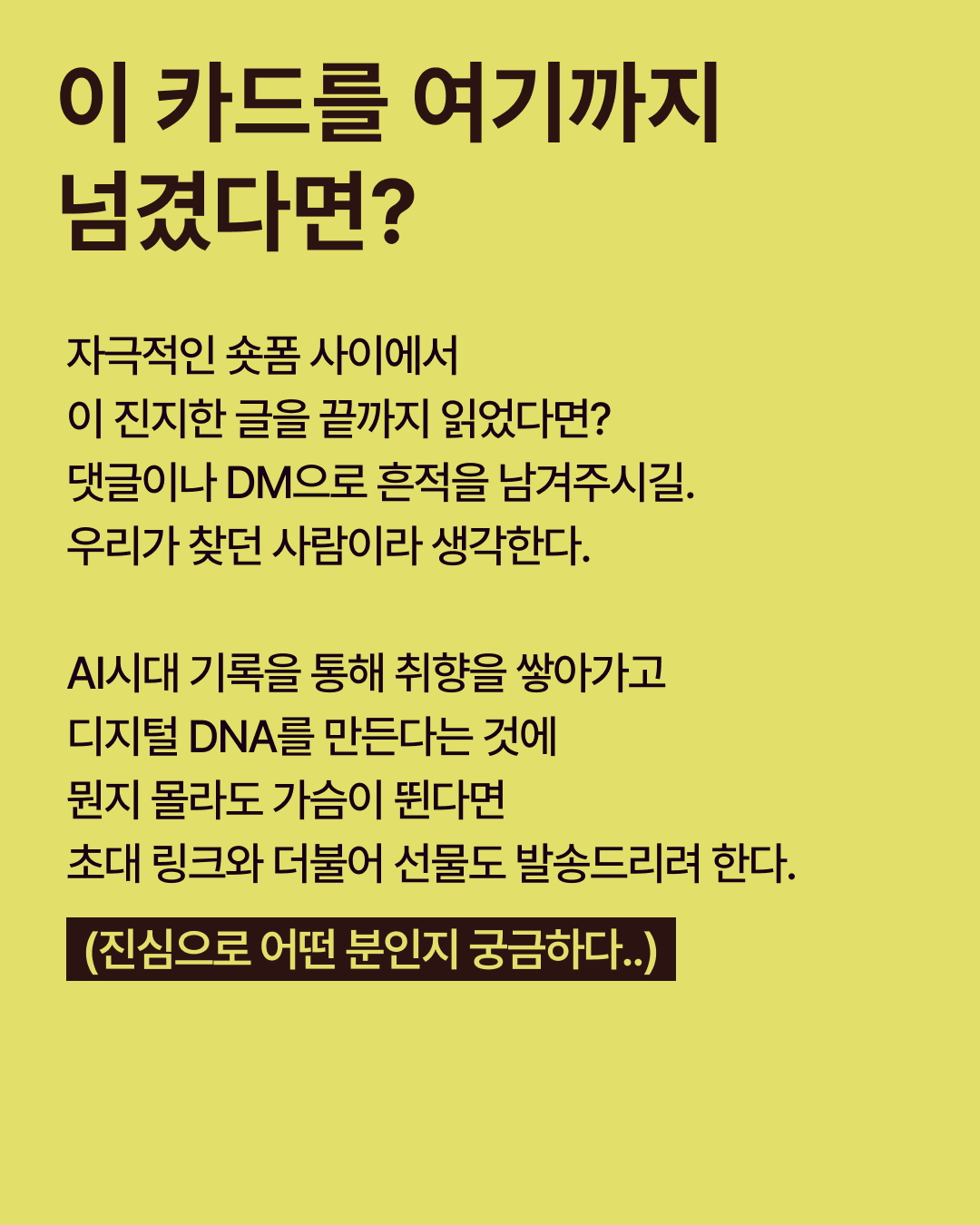
What if you read this all the way to the end?
Then, I invite you to the gardens of 66DAYS. Send me an Instagram DM. There's one thing I hand only to those who read to the end. → Get invited via Instagram DM
Frequently Asked Questions (FAQ)
What does 'humanness' mean in the age of AI?
Humanness isn't about preserving the past — it's something mutable that has been redefined every time technology changes. Now that AI has taken over "execution," humanness shifts toward "the taste and judgment of choosing what to make."
How do you cultivate taste?
Taste comes from records, not declarations. As daily records accumulate, patterns emerge, and within them your own principles and taste are discovered after the fact.
What is 'Digital DNA'?
It's the sum of the records you leave every day. It's the training data that makes your AI agent "yours" on top of the same large language model, and a new kind of humanness that goes beyond the DNA written into your body.
Why 66 days, of all numbers?
According to research from University College London (UCL), it takes an average of 66 days for a new habit to take hold. With repetition, the brain's myelin sheath thickens and your circuits of thought get faster.
Why community rather than going solo?
Online course completion rates are typically just 5%. It's hard to sustain 66 days alone. Community is what lays down that circuit, and it becomes a solidarity of solo founders.
What kind of service is 66DAYS?
It's not a service app — it's a community. Curators in each domain open a "garden" and record 66 days together — Love (relationships), Creation (the unconscious), Selflessness (the body), Sentence (language), Earlywork (direction). To join, reach out via Instagram DM.
Citations and Sources
- Kim Seo-jun (Hashed) — Facebook
- Taste Labs — tastelabs.com
- Lally et al. (2010), European Journal of Social Psychology — 10.1002/ejsp.674
- R. D. Fields (2015), Nature Reviews Neuroscience — 10.1038/nrn4023
- Plato, Phaedrus — Project Gutenberg
More articles